Cryptopolitan
2026-06-08 11:20:15
2026-06-08 11:20:15
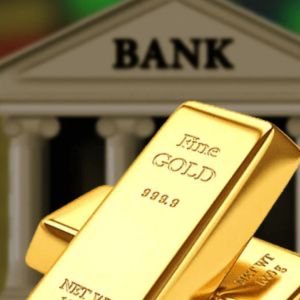
Gold’s worst drop of the year hasn’t shaken wall street bulls
Gold price index printed red as it slid below $4,291 per ounce, posting its weakest price of the year. This comes in when the US labor market conditions improved beyond market estimates. The initial market reaction can be attributed to the growing recognition that rates will remain high for the foreseeable future. Employment figures reportedly increased by 172,000 in May, almost doubling expectations for job additions by 85,000. As a result, investors’ expectations changed dramatically, leading yields to rise to their highest in two weeks and strengthening the greenback’s position. Surprisingly enough, against the background of such aggressive sell-off, a different trend is developing in Wall Street where major banks expect neither cuts in rates in the foreseeable future nor any declines in gold prices . Instead, according to experts’ assessments, the current phenomenon can be considered a structural demand floor in the gold market, which may counterbalance all the negative effects of high interest rates. Why aren’t Gold bulls backing down? May employment figures represent the third consecutive month in which job creation exceeded market expectations. The job creation figures for the previous month have been revised from 115,000 to 179,000, although the unemployment rate remained unchanged at 4.3% based on data from the Bureau of Labor Statistics. The current favorable employment scenario has made it tough for the Federal Reserve as it continues the fight against inflation. According to Beth Hammack, the president of the Cleveland Fed, the current employment scenario is close to full employment, while inflationary pressure could force further tightening of monetary policy. Bond markets responded to this latest news very quickly. As indicated by the CME FedWatch Tool , the market reduced its prospects of an easing move in the coming months, whereas bond yields increased due to more hawkish prospects of monetary policy from the investors’ viewpoint. The effects may not be limited to the US economy alone. The prices for oil went up following the Israeli attacks on military sites in Iran, with Brent oil prices hitting $97 a barrel. Higher energy prices may create additional inflationary pressures as policymakers try to push inflation back to its target level. Strong economic growth, higher energy prices, and inflationary pressures are indications of a higher-for-longer interest rate regime. The structural-demand floor: Why major banks remain bullish on gold despite delayed rate cuts While it is important that the banks postponed cutting rates, what is significant about their response to the jobs report is that they were unwilling to cut their gold estimates. Wall Street still sees Gold climbing Goldman Sachs reportedly pushed back its forecasted first Fed rate cut until June 2027, followed by another cut in December 2027, citing improvements in the labor market and inflation pressure due to tensions in the Middle East. Nomura similarly expects the Federal Reserve to remain on hold through the remainder of 2026. The leading Wall Street banks are still anticipating a marked appreciation in gold prices. The projected price target for gold, according to Goldman Sachs, is $5,400 per ounce. This would be a rise of 25% from here. UBS sees that there will be a jump in the gold price to $5,900 or 36.0%. However, Deutsche Bank forecasts that there will be an increase in the gold price to $6,000. It can be an increase of 38%. Nonetheless, the most optimistic projection for the gold price has been made by JPMorgan. It projects an increase of around 38.3% to 45.2%. It can hit somewhere around $6,000 to $6,300. The banks are still very confident in the growth in structural demand from the central banks. This is where the discrepancy in expectations between gold and monetary policy is apparent. According to the data from the World Gold Council , central banks have been acquiring over 1,000 metric tonnes of gold per year for three years leading up to 2024, one of the longest periods of central bank purchases in history. IMF COFER data , conversely, suggest that there is a steady decline in the US dollar’s share in global foreign exchange reserves. Gold selloff spreads The repricing extended beyond gold. The spot price of silver was down by 6.8% to $68.86, and platinum and palladium were both down by 5.9%. According to Kelvin Wong, senior market analyst at OANDA, the main driver behind this trend was a reassessment of Fed policy, as the interest rate environment put pressure on non-yielding assets. This comes as a marked contrast to what happened early in the year. Gold reached an all-time high of $5,100 per ounce in January after recording six straight months of growth, according to Reuters . The price of gold has since dropped by more than 17% due to the intensification of the American-supported war involving Iran beginning in February. For investors, this is an important test of the bull market for gold until 2026. The next round of US inflation data will play a key role in determining whether the Fed’s hawkish stance translates into action. But if the theory on structural demand presented by Goldman Sachs, JPMorgan, Deutsche Bank, and UBS is accurate, the present sell-off may end up being seen more as an initial pressure test for the gold rally that is being driven more by central banks’ buying than by mere monetary policy decisions. Don’t just read crypto news. Understand it. Subscribe to our newsletter. It's free .
가장 많이 읽은 뉴스
